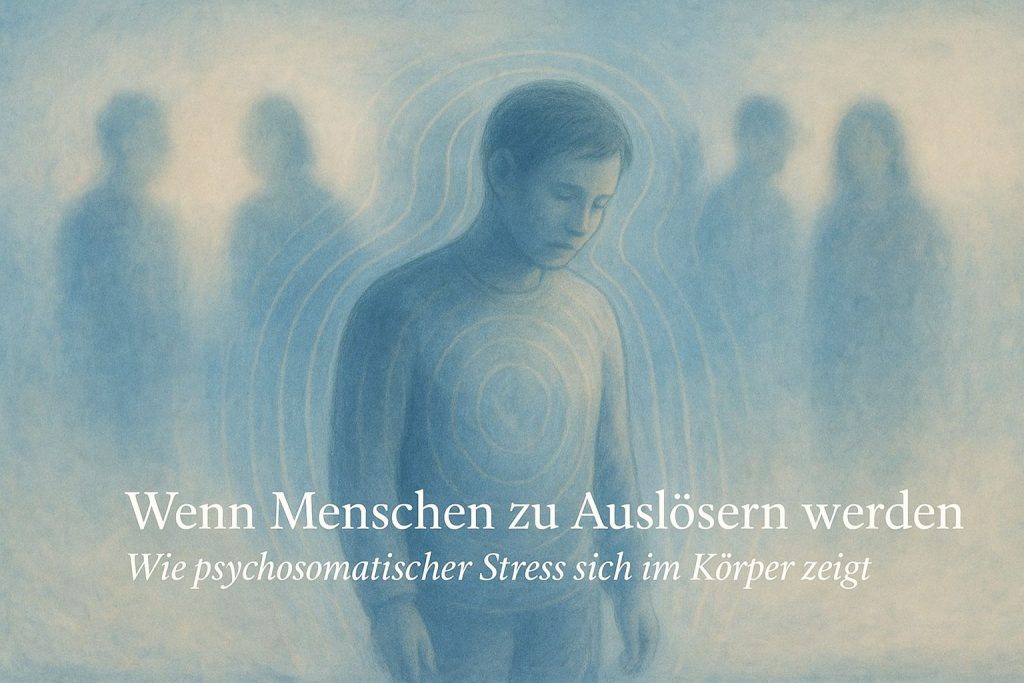
How psychosomatic stress arises in relationships and at work
Many people experience it every day: a sidelong glance, a disparaging remark, underlying tensions within the team – and suddenly the heart races, the stomach cramps, and sleep becomes restless. But what exactly is happening here?
The body reacts before the mind can process it
Our nervous system is a sensitive early warning system. It registers hostile vibes, hidden tensions or subtle disparagement often faster than our thoughts. Even before we can consciously make sense of the conflict, the body has long since reacted. The shoulders tense up, breathing becomes shallow, an inner pressure builds up – even though nobody has said anything ‘bad’. Particularly sensitive people pick up on these signals very early on – and suffer all the more intensely as a result.
Stress caused by people – not by work
It is rarely the task itself that exhausts us. Far more often, it is unspoken tensions, subliminal judgements or the feeling of having to constantly perform without really being seen. The body begins to resist – through pain, tiredness or vague symptoms. Medicine often finds no clear cause. Yet on an energetic level, everything has long been said: the environment is no longer in harmony.
Self-worth through validation – a hidden pattern
Many people unconsciously link their self-worth to external validation. They need recognition, a sense of belonging and good relationships – not out of vanity, but because they have learnt that achievement and conformity are the price they must pay for love and security. If this validation fails to materialise or the atmosphere turns sour, they find themselves in a state of inner distress. Criticism is perceived as rejection, distance as exclusion. A silent sense of being overwhelmed arises – often accompanied by withdrawal, sleep problems or physical tension.
Physical symptoms as an intelligent message
These reactions are not a sign of weakness, but an expression of a highly sensitive inner system. The body reports back what the person often cannot express themselves: “I no longer feel safe. No longer connected.” It signals: I cannot stay healthy like this. And the longer this state persists, the deeper the scars become etched into body and soul.
What matters now
There is no need for drama or blame – but for mindful observation. A conversation, a conscious distance, a clarification of roles. And, in parallel, a re-anchoring in one’s own self-worth: through breathing, silence, grounding, self-reflection. The ability to feel oneself – regardless of others’ opinions – is the first step towards inner stability.
Conclusion
When the body reacts to other people, it is rarely due to sensitivity – but rather to keen awareness. Those who take these signals seriously protect themselves from deeper exhaustion. You don’t always have to leave the situation immediately. But you can learn to re-ground yourself whilst remaining in it.
Gianna